The Life of Jakub Pinkas: Tailor, Pioneer of Pilsner, and Founder of a Prague Institution
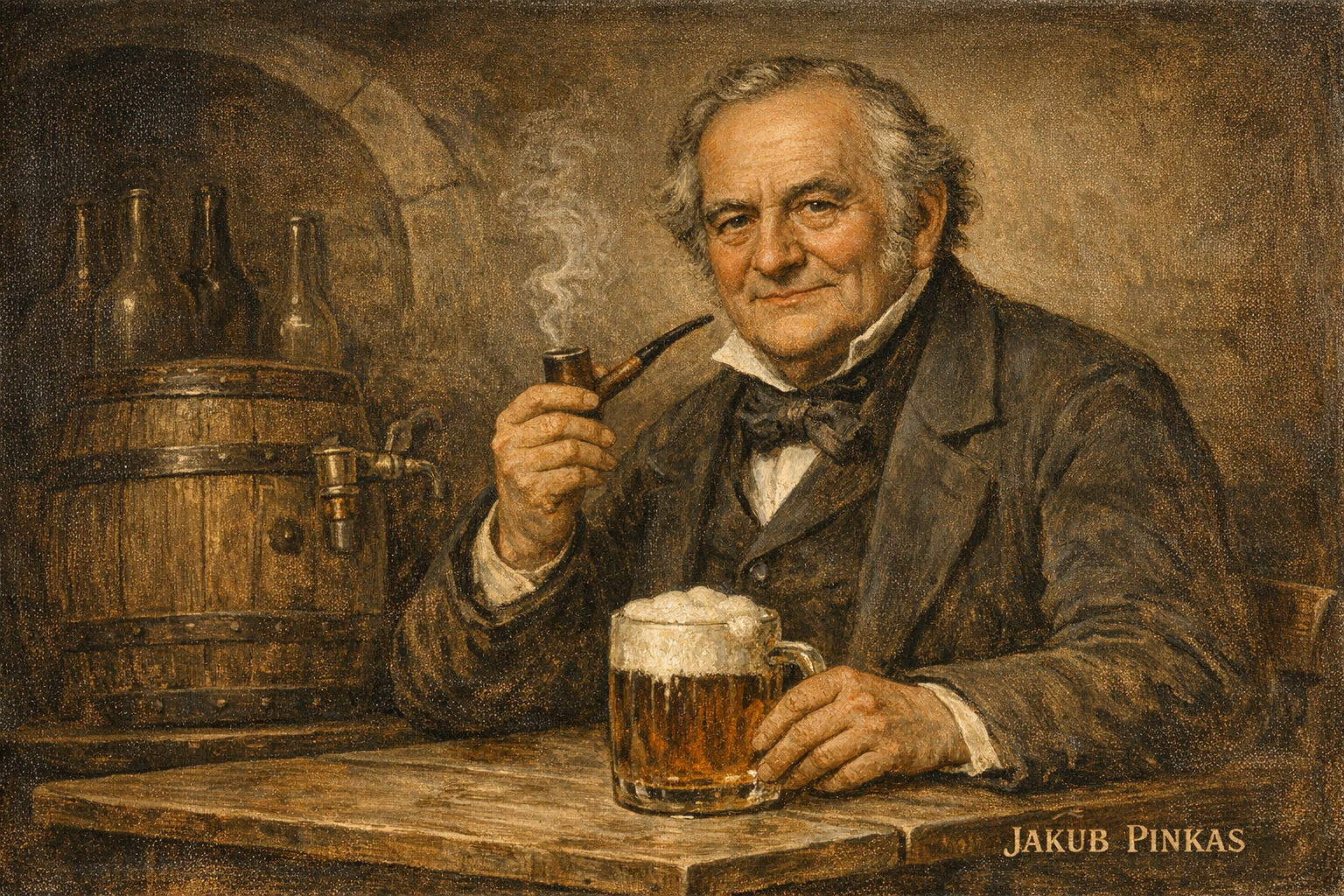
The story of Jakub Pinkas is one of transformation—of a man, a profession, and even a city’s drinking culture. From humble beginnings as a tailor to becoming the first publican in Prague to serve Pilsner Urquell on tap, Pinkas stands as a pivotal figure in the history of Czech beer. His life bridges craftsmanship, entrepreneurship, and cultural innovation, leaving behind a legacy that continues to define Prague’s beer scene today.
Early Life and Background
Jakub Pinkas was born in 1805 in the small village of Budětice, near the city of Plzeň, the future birthplace of the world-famous Pilsner lager. Coming from a modest background, Pinkas learned the trade of tailoring—an occupation that would define his early adulthood.
Like many craftsmen of his time, Pinkas eventually moved to Prague, where economic opportunity and urban growth attracted skilled workers. Settling near Jungmann Square, in the vicinity of the Franciscan Monastery and the Church of Our Lady of the Snows, he established himself as a tailor. His clientele included local residents and even monks, for whom he sewed garments.
At this stage, there was little to suggest that Pinkas would become a figure of national importance. He was, by all accounts, a diligent craftsman living a stable, if unremarkable, life. Yet fate—and beer—would soon alter his path entirely.
A Tailor’s Trade in 19th-Century Prague
Tailoring in early 19th-century Prague was a respected and necessary profession. Clothing was handmade, and tailors played a vital role in both everyday life and ecclesiastical circles. Pinkas, specializing in garments for clergy, would have developed a reputation for precision and reliability.
His workshop likely doubled as a social space, as was common at the time. Customers would visit not only for fittings but also for conversation, news, and community. This blending of commerce and social life would later carry over seamlessly into Pinkas’s next career.
Interestingly, Pinkas’s lack of formal training in hospitality would later become one of his strengths. Without being bound by traditional pub practices, he would innovate in ways that reshaped how beer was served in Prague.
The Turning Point: Encounter with Pilsner Beer
The defining moment in Pinkas’s life came in 1843, just months after the revolutionary new lager from Plzeňský Prazdroj had been introduced in Plzeň. Brewed in 1842 by Josef Groll, this beer was unlike anything the world had seen: golden, clear, and refreshingly bitter.
Pinkas’s connection to this beer came through his friend Martin Salzmann, a carrier who regularly traveled between Plzeň and Prague. In April 1843, Salzmann brought Pinkas two buckets of the new lager to taste.
The reaction was immediate and transformative. Pinkas was captivated by the beer’s flavor and quality. Recognizing its potential, he began offering it to customers from his cellar. Demand quickly grew—not for his tailoring services, but for the beer.
Faced with this unexpected shift, Pinkas made a bold decision: he abandoned his tailoring trade entirely and became a publican.
Founding of U Pinkasů
In 1843, Pinkas established his pub, U Pinkasů, on Jungmann Square. It would soon achieve historic status as the first establishment in Prague to serve Pilsner beer on tap.
This was no ordinary tavern. Pinkas introduced several innovations that set his establishment apart:
Direct tapping from barrels: Instead of pouring beer from large casks into smaller containers, Pinkas served each glass directly from the barrel, ensuring freshness and quality.
Cellar storage: He utilized cool medieval cellars ideal for preserving lager beer.
Efficient service model: Waiters carried multiple glasses at once—sometimes up to fifteen—running between the cellar and the pub floor.
These practices were revolutionary at the time and contributed to the pub’s rapid success.
The popularity of Pilsner beer led to expansion. Pinkas soon extended his premises into neighboring buildings, transforming his once modest operation into a thriving beer hall.
Connection to Pilsner Urquell
Pinkas’s importance in beer history lies not only in his entrepreneurship but in his role as a pioneer of distribution and culture.
At a time when Pilsner Urquell was still new and largely confined to its place of origin, Pinkas introduced it to Prague—a major cultural and economic center. This helped accelerate the spread of the Pilsner style beyond Plzeň.
His pub became a showcase for the new beer, demonstrating its appeal to a wider audience. The success of U Pinkasů proved that bottom-fermented lager could thrive outside its birthplace, paving the way for its global expansion.
Indeed, within decades, Pilsner-style beer would dominate brewing worldwide, with countless imitations and adaptations. Pinkas’s early adoption played a crucial role in this process.
Social and Cultural Influence
U Pinkasů quickly became more than just a pub—it was a social hub. Among its regulars were prominent Czech intellectuals and political figures, including František Palacký and František Ladislav Rieger, who reportedly had their own tables.
Students, writers, and journalists also frequented the establishment, making it a lively center of discussion and cultural exchange. Pinkas himself was known as a strict but fair innkeeper, maintaining order while fostering a welcoming environment for his patrons.
His pub reflected the changing nature of urban life in 19th-century Prague—a place where ideas, politics, and culture intersected over a shared appreciation for beer.
Later Life
As the years passed, Pinkas remained closely associated with his establishment. By the mid-19th century, he had firmly established himself as a respected figure in Prague’s hospitality scene.
His transition from tailor to innkeeper was not merely a career change but a complete reinvention. He had successfully navigated the risks of entrepreneurship and capitalized on a revolutionary product at just the right moment.
Despite his success, Pinkas appears to have maintained a relatively grounded life, focusing on his business and community rather than seeking broader fame.
Death
Jakub Pinkas died in 1879 at the age of 74.
By the time of his death, his pub had already become an institution. It had survived decades of political and social change, and its reputation as a center of beer culture in Prague was firmly established.
Legacy
The legacy of Jakub Pinkas is profound and multifaceted.
- A Pioneer of Czech Beer Culture
Pinkas was instrumental in introducing Pilsner beer to Prague, helping to transform it into a national—and eventually global—phenomenon. His early adoption and promotion of the beer contributed to the rise of lager as the dominant beer style worldwide.
- Founder of an Enduring Institution
U Pinkasů remains one of Prague’s most famous and historically significant pubs, operating continuously for over 180 years.
Visitors today can still experience the atmosphere that Pinkas helped create, including the tradition of serving Pilsner beer in its freshest form.
- Innovator in Beer Service
Pinkas’s methods of serving beer—direct tapping, cellar storage, and emphasis on freshness—set new standards that influenced pub culture far beyond Prague.
- Cultural Figure
Through his establishment, Pinkas contributed to the intellectual and social life of Prague. His pub became a gathering place for influential figures, reinforcing the connection between Czech beer and national identity.
Conclusion
The life of Jakub Pinkas is a testament to the power of opportunity, innovation, and bold decision-making. From a modest tailor serving monks in Prague, he became a key figure in one of the most important developments in beer history.
His decision to embrace a new and unfamiliar product—Pilsner Urquell—and to build a business around it changed not only his own life but also the cultural landscape of Prague and beyond.
Today, every glass of Pilsner served in the Czech capital carries a trace of his legacy. And in the bustling rooms of U Pinkasů, where beer continues to flow as it did in 1843, the spirit of Jakub Pinkas lives on.
Image: Illustrative