František Ondřej Poupě: A Pioneer of Czech Brewing
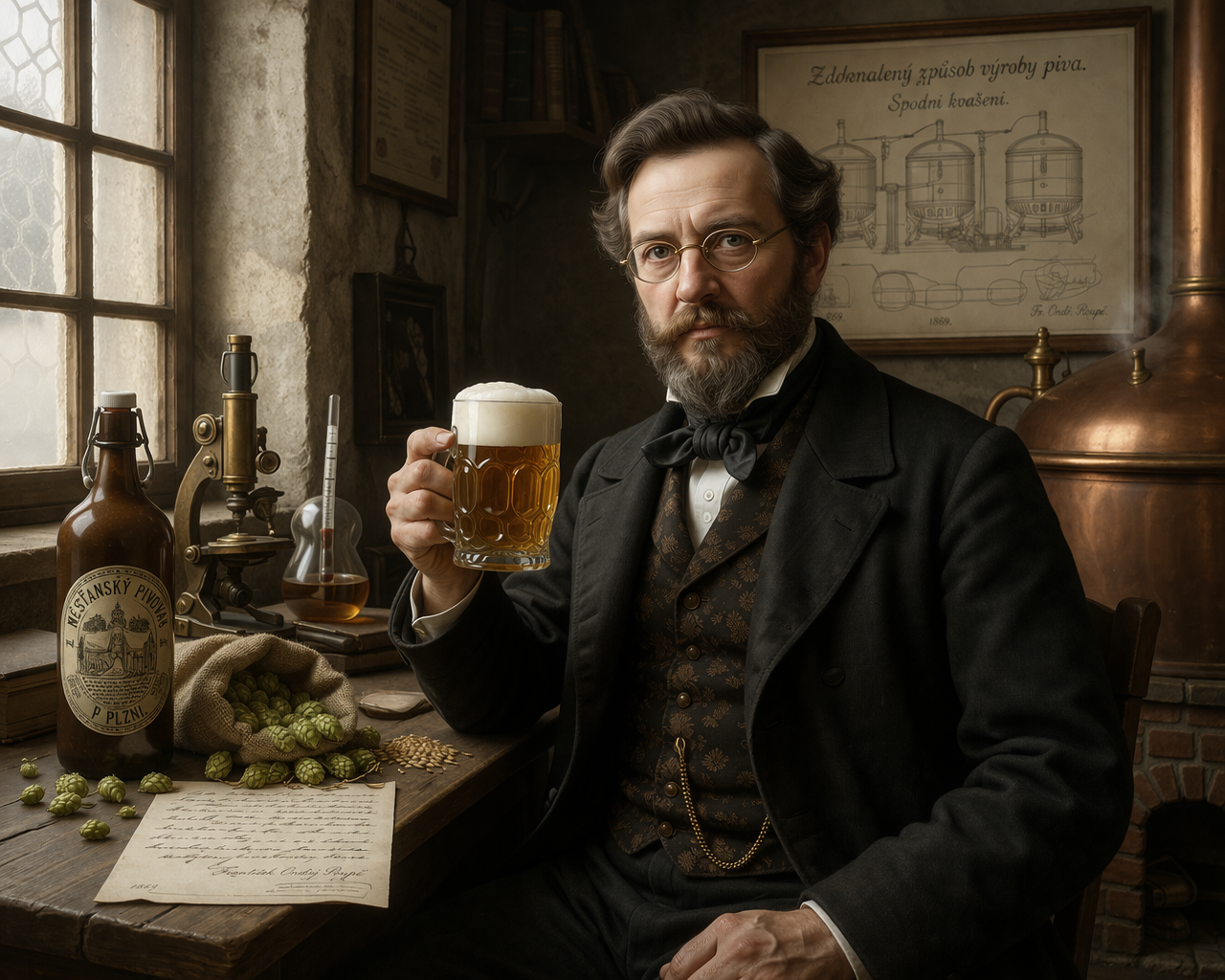
When we think of Czech beer today — acclaimed around the world for its quality, character, and historical tradition — few realize how deeply this craft was shaped by a single human being over two centuries ago. František Ondřej Poupě (26 November 1753 – 1 December 1805) was much more than a brewer. He was an innovator, scientist, author, and educator whose work transformed beer production from artisanal practice into a practical science.
Long before the rise of Plzeňský Prazdroj and the fame of the lager style, Poupě was already refining brewing techniques in the late 18th century. His contributions helped lay the groundwork not just for Czech beer, but for professional brewing methods across Europe.
Early Life and Education
František Ondřej Poupě was born on 26 November 1753 in Český Šternberk, a small town in what is now the Czech Republic. He was the son of a blacksmith — a modest artisan background that did not foreshadow the far-reaching influence he would later have.
Although his early education was simple, Poupě’s destiny began to take shape through family connections in brewing. Before he reached adulthood, he began his apprenticeship under his older brother Jan, who was a brewer in Velká Bíteš. There, Poupě learned the fundamentals of beer production — from grain selection and mashing to fermentation and cellar management.
This early education sparked a lifelong fascination with the science behind brewing — not merely how to make beer, but why each step mattered and how it could be improved. Poupě was intellectually curious, and his subsequent travels and work experiences would expose him to diverse techniques that he would eventually refine and codify.
Early Brewing Career and Travels
After his apprenticeship, Poupě spent several years traveling and working in breweries across various regions, both within the Czech lands and beyond. These early experiences included positions in Třebíč and other towns where he continued to hone his craft.
His work in different breweries gave him valuable insights into varying regional styles and methods. But more importantly, Poupě began to ask questions that few brewers had asked before: How could consistency be improved? What aspects of the process could be measured and controlled? How could beer quality be better standardized?
He soon developed a reputation as a reform-minded brewer — one who was not content with tradition alone, but sought to improve and innovate. These early years laid the groundwork for his later work in Brno and his influential writings on brewing.
Marriage and Personal Life
In 1783, Poupě married Anna Herzová. Their union would eventually produce six children: Anna (b. 1784), Tereza (b. 1786), Alžběta, Josefa, Johanka, and František. Even as he raised a family, Poupě continued to pursue his brewing career with ambition and insight.
Ten years later, as his professional life began to take off, Poupě settled in Prague, and later Slaný, where he continued to apply his brewing knowledge and develop new methods.
Scientific Approach to Brewing
What set Poupě apart from nearly all of his contemporaries was his scientific approach to brewing. At a time when brewing was largely governed by tradition, intuition, and local rules, Poupě began treating beer production as a field of empirical investigation. He examined processes on a chemical and physical basis — a revolutionary concept for his time.
Among his notable innovations:
- The Use of the Thermometer and “Pivní Váha”
Poupě was one of the first brewers to systematically use a thermometer during brewing to control temperature — a crucial factor in fermentation quality. He also devised a device known as the “pivní váha” (“beer weight”), a precursor to the modern hydrometer used to measure wort density and monitor fermentation activity.
These innovations helped brewers understand how temperature and sugar concentration impacted fermentation — insights that would later become fundamental to modern brewing science.
- Standards for Ingredients
Poupě was a strong advocate for the appropriate use of ingredients. Famously, he remarked on the proper role of grains in brewing, insisting that barley should be used for beer, while other grains such as wheat or oats had other purposes. This emphasis on purity and ingredient quality was ahead of its time.
These scientific principles helped move brewing from craft toward a more standardized, controlled, and predictable industry.
Publications and Writings
Poupě was not only a practitioner — he was also a writer and teacher.
First Published Works
In 1794, he published his first brewing treatise — Die Kunst des Bierbrauens (“The Art of Brewing”) — written in German, then the lingua franca of European learned culture. This work encapsulated his brewing philosophy and practical knowledge.
Later, in 1801, he published Počátkové základního naučení o vaření piva (“The Basic Principles of Beer Brewing”) — one of the first Czech-language textbooks on brewing and malting. These works helped disseminate his approach far beyond any single brewery.
Poupě’s writings were not merely technical manuals; they reflected a broader intellectual curiosity about fermentation, chemistry, and the larger science behind brewing — and influenced generations of brewers who followed.
Major Career: The Brno Years
While Poupě worked in several breweries throughout his career, the most pivotal chapter came with his appointment as head brewer in the Brno Municipal Brewery in 1798.
Winning this prestigious position was a culmination of years of successful work and growing reputation. In Brno, Poupě found a stable and productive environment where he could implement his ideas at scale.
Transforming the Brno Brewery
At the Brno brewery, Poupě’s influence was immediate and transformative:
Production increased significantly — from around 16 000 hectoliters annually to nearly 28 000 hectoliters within a few years.
He modernized equipment and processes, increasing both efficiency and consistency.
Brno became a center of brewing excellence, drawing brewers and apprentices from across the region to study under him.
Poupě’s work in Brno elevated the brewery’s reputation and made it a model for others, proving that rigorous methods could be married with tradition to produce beer of superior quality.
A Brewing Teacher
Unlike many brewers of the era, Poupě was also dedicated to teaching. He is credited with founding one of the first brewing schools, where students from various regions came to learn both theory and practice.
This educational legacy — training brewers to think analytically about fermentation and beer production — further amplified his influence throughout Europe.
Later Life and Death
Despite his towering contributions, Poupě’s life was not without hardship. He endured criticism and resistance from traditionalists who were suspicious of his methods. Moreover, later in life, he suffered from pulmonary disease, a condition that would ultimately claim his life.
On 1 December 1805, František Ondřej Poupě died in Brno at the age of only 52. His death marked the end of a relatively short life, but one that had an outsized impact on beer culture and brewing science.
Legacy and Influence
Today, Poupě is recognized as a foundational figure in Czech beer history. He is remembered not just for the beer he brewed, but for how he thought about brewing — blending practical craft with scientific method.
Czech brewing associations award prizes in his name to recognize contributions to brewing and related disciplines.
In Brno, his legacy is celebrated through historical exhibits, statues, and renewed brewing traditions connected to the original municipal brewery where he once stood.
His writings continue to be recognized as early cornerstones in brewing literature, and his methods anticipated elements of modern brewing science.
Without Poupě’s insistence on quality, precision, and scientific understanding, it is fair to say that Czech beer might have evolved very differently. He helped establish a culture in which brewers were not just craftworkers, but thinkers — a legacy that resonates in every Czech brewery today.
Conclusion
František Ondřej Poupě’s life is a testament to the power of curiosity, persistence, and innovation. From his humble beginnings in Český Šternberk, apprenticeship under his brother, and years of travel, through his pioneering use of scientific tools in brewing, to his leadership in Brno — his contributions were profound and lasting.
He elevated beer production from a set of traditional practices to a disciplined craft grounded in measurement, experimentation, and education. His legacy lives on not only in Czech brewing culture but in the very principles that guide professional brewing worldwide.
In the story of Czech beer, Poupě stands as one of its most influential figures — a man whose life was dedicated to understanding and perfecting the golden art that continues to be both tradition and pride for Czechia and beer lovers everywhere
Image: Illustrative